The Royal Oak Chronograph adds three registers to a design that is already defined by strict geometry. That makes the dial unusually sensitive to spacing. The bezel, screws, tapisserie pattern, hour markers and subdials all have to sit within the same visual grid. If one element is noticeably out of position, the error can be easier to see than on a round chronograph.

Subdial position is more important than factory reputation
The original article spent much of its space ranking older factory versions. That information ages quickly and can become misleading when production changes. The useful observation is simpler: compare the distance between the three registers, their relationship to the hour markers and the way the date window fits into the dial.
A register that is slightly too close to the centre or too large changes the balance of the Royal Oak immediately. Printed scales also need to remain crisp over the tapisserie texture. These are visible points that can be checked without relying on a seller’s quality ranking.

Chronograph appearance and chronograph function are separate
Some replica chronographs reproduce the correct dial layout while using movements that do not drive every register in the same way as the genuine watch. This page no longer assumes full functionality from appearance alone. Each register should be tested to establish what it actually measures and whether the hands reset consistently.
That distinction is important because fixed or decorative hands can still look convincing in photographs. A careful comparison should therefore state whether it is discussing dial accuracy or mechanical behaviour.
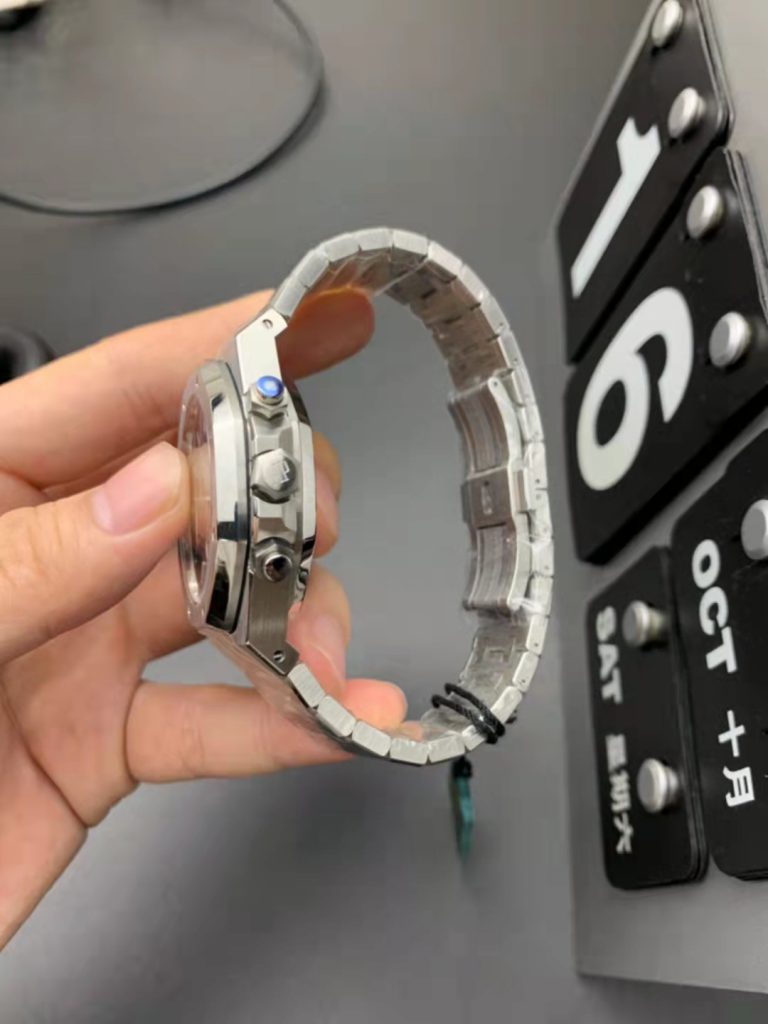
The Royal Oak case still does most of the visual work
Brushing direction, polished bevels and the alignment of the eight bezel screws define the watch before the chronograph is considered. The bracelet should continue those surfaces from the case without abrupt changes in finish. Soft edges or irregular links can make the watch look less precise even if the dial is strong.
Our Audemars Piguet replica coverage uses the same case first approach across Royal Oak and Royal Oak Diver models because the geometry is central to the identity of both.
Bracelet finishing should continue the case lines
The Royal Oak bracelet is not a separate accessory visually. Its broad brushed links and polished bevels continue the geometry of the case, so inconsistent finishing at the first links can be especially obvious. The bracelet should taper naturally and each link should articulate without creating irregular gaps.
For an older replica, wear and looseness can also reveal more than a factory name. A well preserved case with a loose bracelet may feel less coherent than a slightly less sharp case paired with tighter, better aligned links.
Why this older page is still worth keeping
The URL received Search Console impressions, and the subject remains useful. What needed to change was the framing. Factory rankings, claims of best quality and outdated market commentary have been replaced by a clearer explanation of what readers can inspect for themselves.
SpankWatches keeps the page as an editorial comparison rather than a purchasing recommendation. That makes the article more durable even as individual replica versions change.
