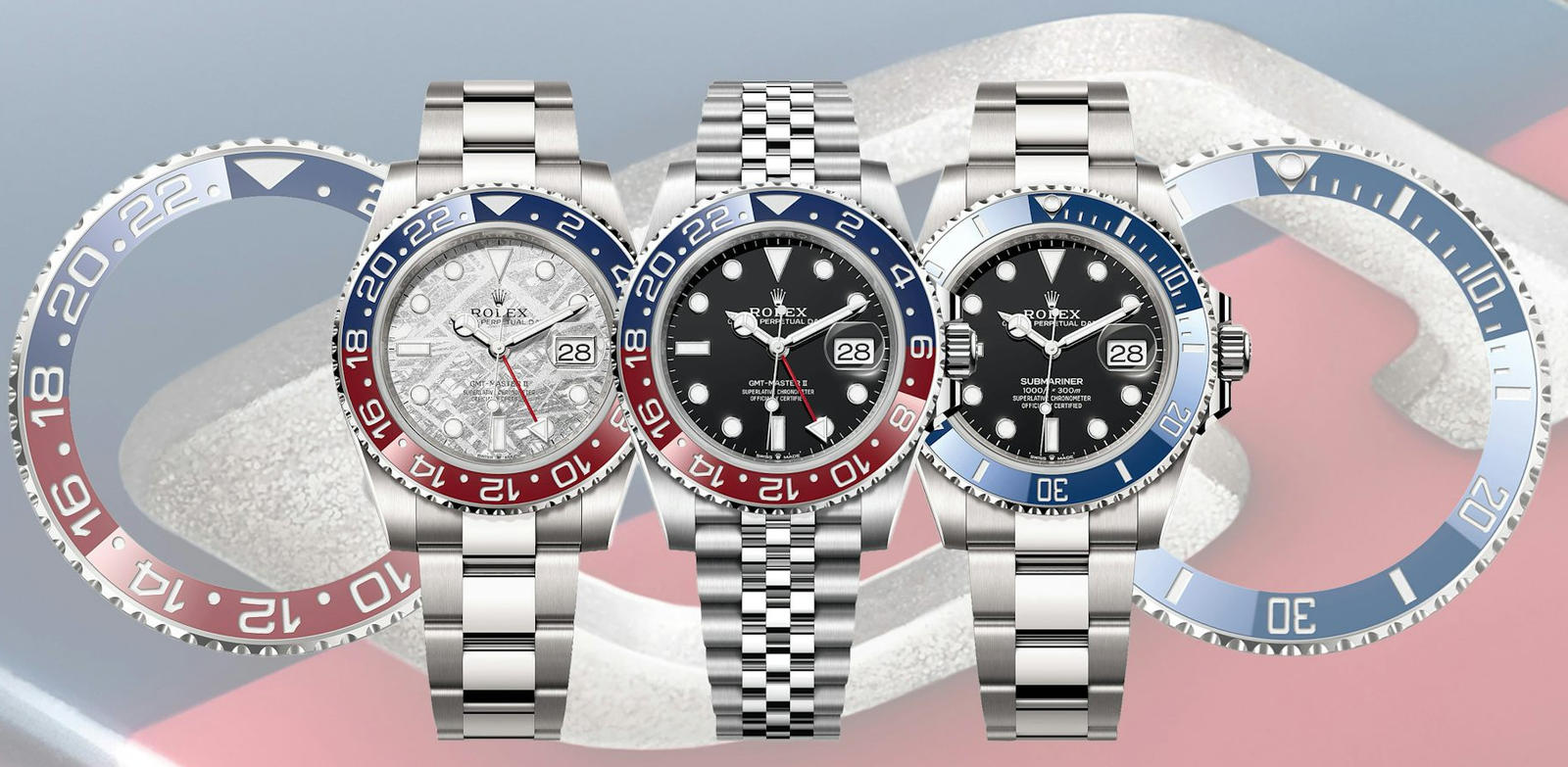
The Rolex GMT-Master II Pepsi has always been more than a recognisable red and blue bezel. Its appeal comes from a design that has remained closely connected to the original purpose of the GMT-Master: displaying a second time zone in a clear and practical way. That combination of useful functionality and distinctive styling helped make the Pepsi one of the most recognisable watches in the Rolex professional range.
Its removal from the 2026 collection therefore attracted considerable attention. The Oystersteel reference 126710BLRO and white gold reference 126719BLRO disappeared from Rolex’s current catalogue during the Watches and Wonders product update. The white gold Submariner Date reference 126619LB, commonly known as the Cookie Monster, also left the range. For GMT-Master II enthusiasts, however, the Pepsi is the more significant departure because its red and blue colour combination has such a long history within the collection.
For readers interested in replica watches UK, the change also provides a useful opportunity to examine what makes this particular reference distinctive. The modern Pepsi combines a recognisable historical design with a relatively sophisticated GMT mechanism, and the details become much more interesting when the bezel, dial, hands and bracelet are considered together.
The Design Behind the Pepsi GMT-Master II
The GMT-Master first appeared in 1955, during the expansion of international commercial aviation. Rolex developed the watch for professionals travelling across multiple time zones, and its subsequent association with Pan American World Airways helped establish its reputation among pilots and frequent travellers.
The original red and blue bezel had a practical purpose. Its two colours separated the daytime and nighttime portions of the 24-hour scale, making the second time zone easier to read. Over time, that functional detail became the defining visual feature of the Pepsi, surviving changes in case design, bezel materials and movement technology.
The modern ceramic version took shape in 2014 with the white gold reference 116719BLRO. The Oystersteel 126710BLRO followed in 2018, initially with a Jubilee bracelet. An Oyster bracelet option arrived in 2021, giving the same reference a more traditional sports-watch appearance.
The Rolex GMT-Master II Pepsi 126710BLRO uses a 40mm Oystersteel case, black dial and red and blue Cerachrom bezel. Unlike earlier aluminium inserts, the ceramic construction is highly resistant to scratches and fading. Producing the two contrasting colours within one ceramic component also required considerable technical development.
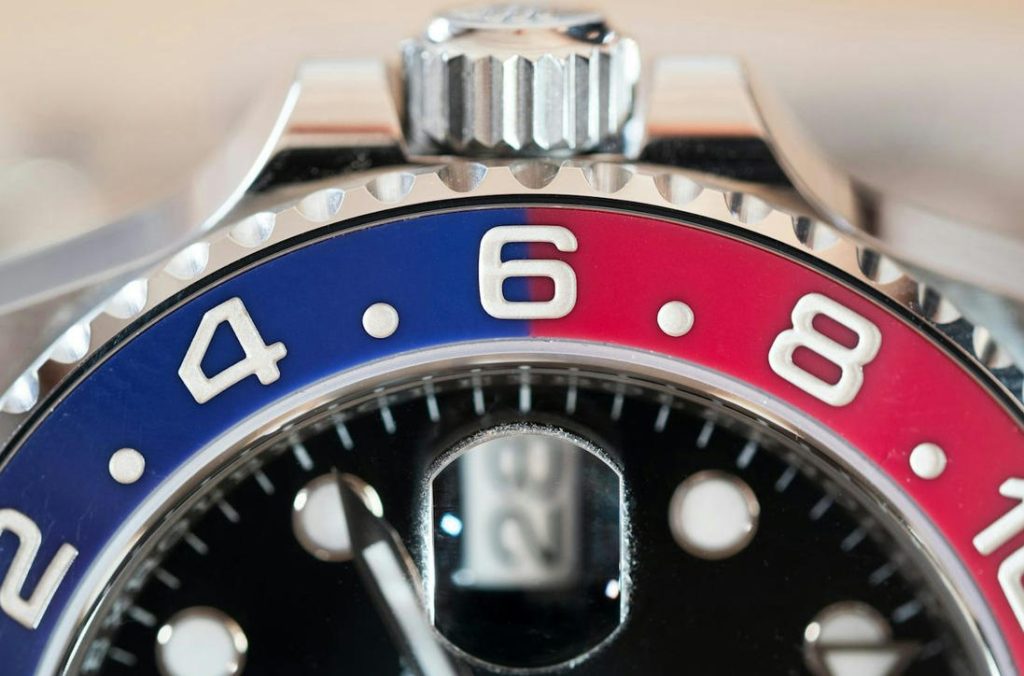
The bezel is not simply a decorative feature. Its 24-hour graduation works with the additional GMT hand to display another time zone. The wearer can independently adjust the local hour hand in one-hour increments without losing the reference time shown by the GMT hand. This makes the GMT-Master II second time zone function particularly useful when travelling between countries.
The bracelet changes the character of the watch without altering its essential design. The Jubilee uses five-piece links and gives the Pepsi a more detailed, traditional appearance. The three-piece Oyster bracelet looks more restrained and gives the watch a stronger professional sports-watch character. Neither is inherently better; the difference is largely a matter of proportion and personal preference.
The white gold 126719BLRO takes the same red and blue bezel in a different direction. Its precious metal construction and blue lacquer or meteorite dial options give it a more individual appearance than the Oystersteel version. Although the two references share the Pepsi identity, their materials and dial treatments make them noticeably different watches.
What Matters When Comparing GMT-Master II Replica Watches
The modern Pepsi is a useful example of why reproducing a familiar watch design involves more than matching its colours. The bezel, dial, hands, case and bracelet have to work together. If one element is out of proportion, the overall appearance can quickly lose the balance that makes the original recognisable.
The red and blue Cerachrom insert is an obvious starting point. The colour transition, 24-hour markings and alignment with the dial all influence the finished appearance. Differences in the shade of red or blue can be particularly noticeable because the bezel occupies such a prominent position on the watch.
The black dial is comparatively simple, but its details matter. The luminous hour markers, Mercedes-style hour hand, triangle-tipped GMT hand and date window each have a specific position and proportion. The Cyclops lens also changes how the date is presented, making its alignment and magnification important when examining the overall design.
Case construction deserves equal attention. The relationship between the 40mm case, bezel width, crown guards and lugs determines how the watch sits visually. A case that is too thick or has poorly shaped lugs can make an otherwise familiar design look noticeably different.
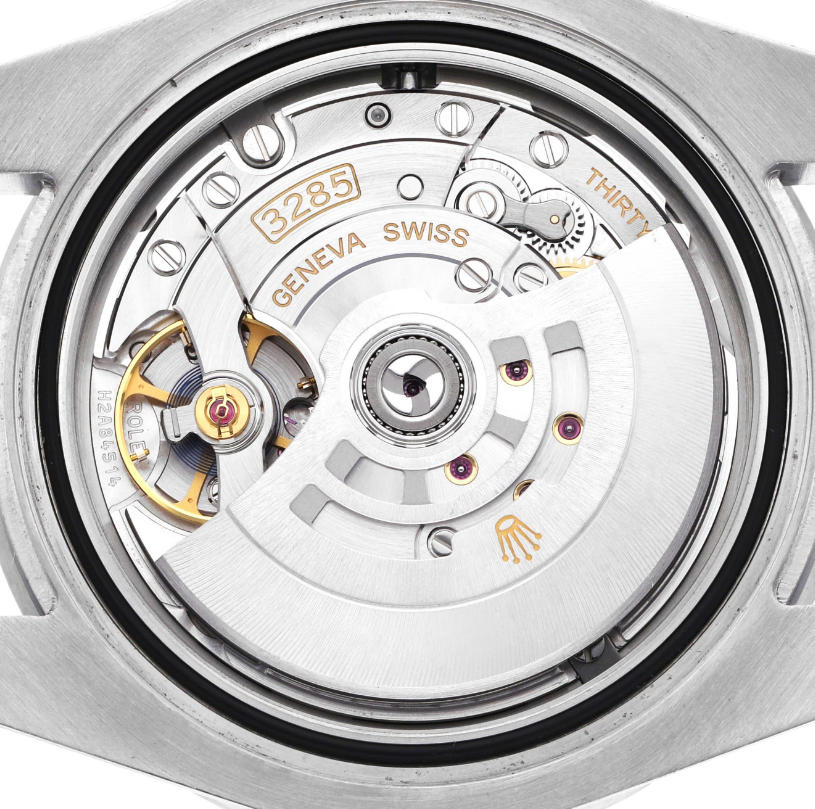
The original 126710BLRO is powered by Rolex Calibre 3285, with approximately 70 hours of power reserve. It provides the independent local-hour adjustment that defines the GMT-Master II. A Rolex GMT-Master II Pepsi replica watch should therefore not be judged only by whether it has a similar-looking GMT hand. The actual movement configuration and operation are separate considerations.
When examining GMT-Master II replica bezel and dial details, it is more useful to consider individual construction and alignment than rely on descriptions such as AAA or 1:1. Those expressions are not recognised technical standards and do not establish mechanical reliability, accuracy or water resistance.
There is also an important distinction between visual similarity and functional similarity. A watch may reproduce the general appearance of a GMT-Master II while using a different movement with different time-setting arrangements. Movement architecture, regulation and long-term performance require separate verification rather than assumptions based on photographs.
Readers looking at other versions and configurations can explore our GMT-Master II replica watches section for further coverage of the collection.
What the 2026 Discontinuation Changes
The departure of the Pepsi leaves a noticeable gap in the current Rolex range, particularly for collectors who associate the GMT-Master II with its original red and blue colour combination. The black and blue, black and grey, and green and black configurations offer different identities, but none carries exactly the same historical association.
The Cookie Monster’s departure adds to the significance of the 2026 update, although it belongs to a different category. Its 41mm white gold case, blue ceramic bezel and black dial gave the Submariner Date a distinctive precious metal appearance. It was a very different proposition from the travel-focused GMT-Master II.

For UK collectors, the important distinction is between the discontinued references and the wider history of each collection. The Oystersteel Pepsi, white gold Pepsi and earlier aluminium-bezel models each represent different stages in the development of the GMT-Master.
Discontinuation can increase attention, but it does not automatically guarantee future price growth. Condition, original configuration, documentation, availability and buyer demand remain important when assessing any pre-owned Rolex.
The Pepsi’s lasting appeal comes from the way its design and function support each other. The red and blue bezel provides an immediate identity, while the GMT hand and independently adjustable local hour make the watch genuinely useful. That combination is more important than its recent disappearance from the catalogue.
For anyone studying the Rolex GMT-Master II or comparing its replica interpretations, the 126710BLRO remains a particularly interesting reference. Its proportions, ceramic bezel, bracelet options and dual-time display explain why the Pepsi became such a recognisable part of modern Rolex design. The 2026 collection change may have ended its current production run, but it has not diminished the importance of the design itself.
